
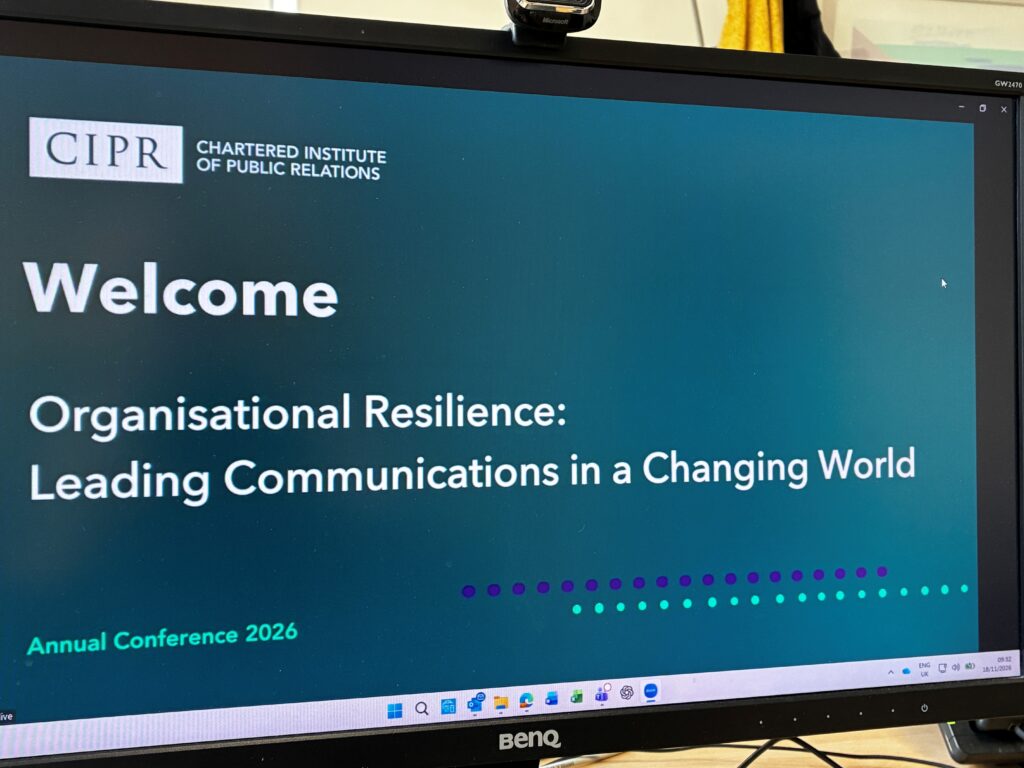
Managing Client Director Adam Riddell reflects on the 2026 CIPR Annual Conference…
The range of speakers at this week’s CIPR annual conference reflected how the role of communications professionals is continuing to evolve.
For many years, communications has often been viewed through a relatively tactical lens: managing media relations, producing content, ensuring that an organisation’s messages reach the right audiences.
These activities remain important, of course, but the conversations and perspectives shared at the event this year reinforced just how far the profession has moved beyond this more ‘traditional’ remit.
Increasingly, public relations is being recognised as a strategic advisory function, helping organisations remain resilient, and navigate an environment defined by economic volatility, geopolitical uncertainty, technological disruption and increasingly complex stakeholder expectations.
It provided a welcome reminder of where public relations can add value, and an indication of the future trajectory of the industry.
And it’s a shift that should resonate clearly with firms in the international financial services space, operating across multiple jurisdictions, regulatory frameworks and political environments, often serving clients and stakeholders with very different expectations.
For these organisations, economic volatility, geopolitical developments, regulatory change, reputational risk and the growing influence of AI are not isolated communications challenges; they are business-critical issues that demand informed, joined-up strategic counsel. Public relations professionals teams in the sector increasingly need to understand not just how to tell the story, but the wider forces shaping it.
Navigating uncertainty
A recurring theme throughout the conference was the sheer complexity of the environment in which organisations now operate.
In this environment, communications cannot simply be brought in at the end of a decision-making process to explain or promote what has happened. It needs to be part of the conversation much earlier, helping leadership teams understand the external landscape, anticipate stakeholder reactions, identify emerging risks, scenario plan around potential future uncertainties, and ultimately make better-informed decisions.
Speakers at the conference also alluded to the challenge of an environment in which misinformation, disinformation and increasingly sophisticated forms of digital manipulation can spread rapidly.
Reputation is no longer shaped exclusively by what an organisation says about itself, or even by what traditional media reports. It is influenced by a much broader and less predictable ecosystem of online commentary, social platforms, artificial intelligence and competing narratives.
This all places crisis preparedness firmly on the strategic agenda – not simply responding quickly when something goes wrong, but understanding vulnerabilities, scenario planning, establishing clear decision-making structures and ensuring that organisations have the resilience to respond effectively when challenged. PR and comms professionals have an important role here, in making sure that organisations are prepared, beyond just being equipped with a reactive media statement.
Perhaps the most important takeaway from this year’s conference was that the public relations profession has an opportunity now to redefine its place within organisations. As businesses face greater uncertainty and more interconnected risks, the ability to communicate effectively is integral to organisational resilience, leadership, governance and long-term success.
The ability to interpret what is happening beyond an organisation’s immediate boundaries, understand its implications and translate that intelligence into practical advice is now a critical professional skill.
This demands more than technical competence. It demands commercial awareness, sound judgement, an understanding of geopolitics and economics, the confidence to challenge senior decision-makers and the ability to connect communications activity to wider organisational objectives.
Across the sessions at this year’s event, there was a clear thread – from internal team motivation, productivity and crisis management, to misinformation, AI adoption and resilience, the public relations profession’s real strategic value lies in helping organisations understand the world around them, make better decisions and maintain the confidence of the people who matter most.